

Introduction
High-end residential projects require more than strong design intent. They demand precise coordination between architecture, structure, and construction execution.
At Mediterra, collaboration with architects is approached as a structured process, not an informal handoff. The goal is not simply to build what has been designed, but to ensure that architectural intent is preserved, refined, and executed with clarity from early planning through to completion.

Interior and exterior spaces are developed in alignment, ensuring continuity in proportion, materiality, and spatial experience.
Role Within the Project Framework
Collaboration is most effective when roles are clearly defined from the outset.
Within residential projects, the architect establishes the design direction, spatial organization, and overall architectural language of the home. Our role is to support that vision through technical coordination, constructability review, and disciplined execution.
This position is not one of reinterpretation, but of alignment, ensuring that the architectural intent can be carried through the realities of construction without loss of clarity.
By engaging early in the process, we are able to contribute to decision-making at the appropriate stage while maintaining respect for the design leadership established by the architect.
Working from Architectural Intent, Not Just Drawings
Every project begins with a clear understanding of the architectural direction including proportion, material expression, and how the residence is intended to relate to the surrounding landscape.
Rather than approaching drawings as fixed instructions, we review them in the context of buildability, sequencing, and real-world site conditions. This allows us to identify potential conflicts early, while maintaining alignment with the design vision.
The objective is to ensure the architecture can be delivered as intended, without loss of clarity or proportion.
Early Coordination Reduces Friction Later
One of the most common challenges in residential construction is fragmentation, where architecture, landscape, and interior scopes are developed independently and coordinated too late in the process.
When coordination is deferred, conflicts emerge in areas such as grading, structural interfaces, material transitions, and service integration. These issues often require on-site adjustments that compromise both design intent and project efficiency.
Our approach emphasizes early-stage coordination, where these relationships are reviewed in the context of the architectural design before construction begins. This allows for informed decision-making, reduces uncertainty, and protects both the integrity of the design and the overall project timeline.
Aligning Design with Construction Realities
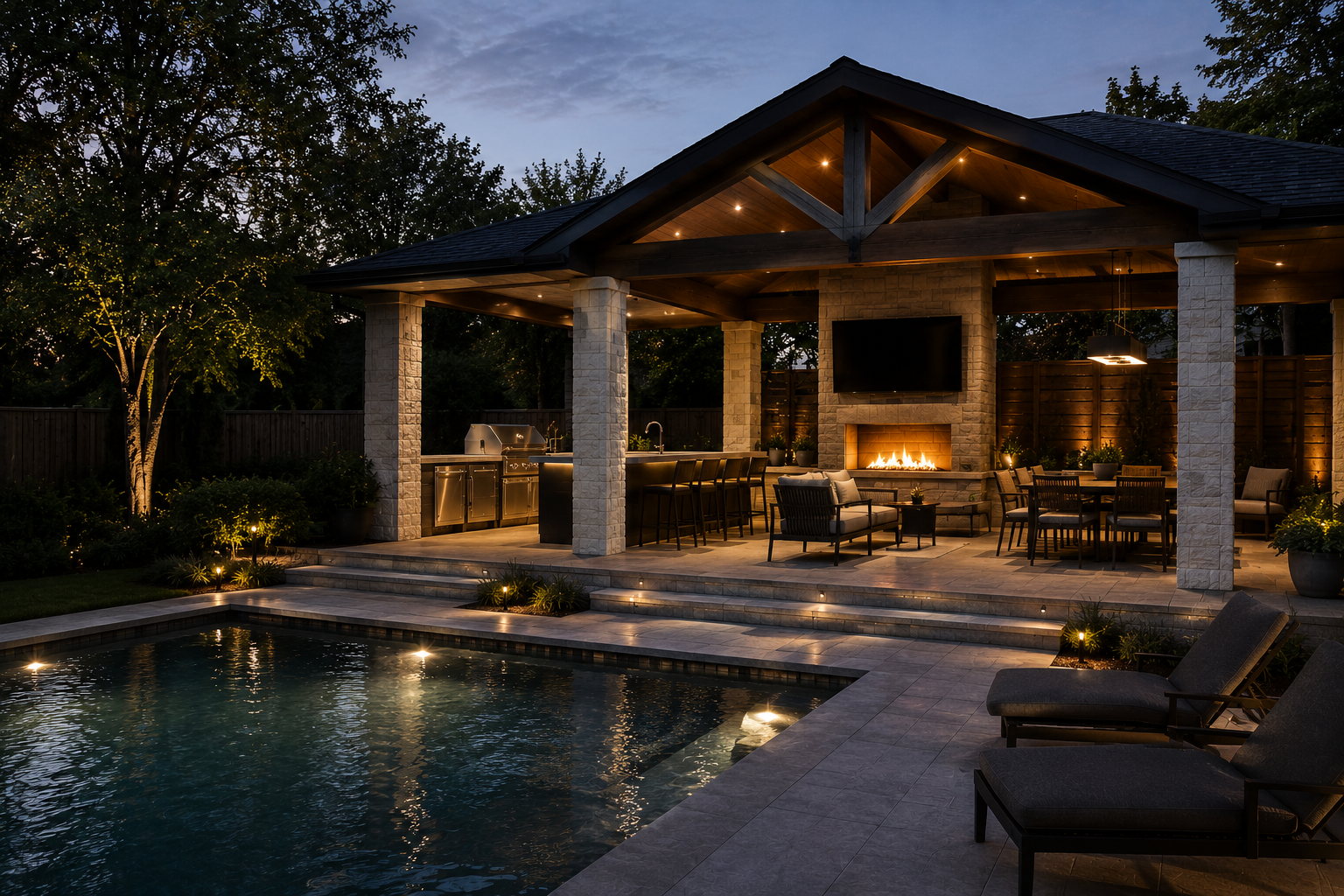
High-end residential work often involves complex detailing, from exterior cladding transitions and structural spans to integrated outdoor elements such as pools, pavilions, and terraces.
Our role is to bridge the gap between design and execution. This includes:
Reviewing details for constructability
Coordinating with engineers and consultants
Verifying material performance in exterior conditions
Maintaining alignment between drawings and site conditions
This level of coordination ensures that the built result reflects the design, rather than a compromised version of it.
Maintaining Design Integrity Through Execution
Execution is where many projects lose their clarity. Without consistent oversight, small deviations can accumulate, impacting proportion, alignment, and material continuity.
At Mediterra, we maintain direct involvement throughout construction to ensure that architectural intent is carried through each phase of the build. Trade coordination, sequencing, and detailing are managed with a focus on precision and consistency.
This requires not only technical coordination, but a disciplined approach to decision-making throughout the construction process.
The result is a finished environment that reflects the original design vision, without compromise.

The residence and surrounding landscape are designed as a unified composition, where architecture, lighting, and exterior spaces are resolved as a cohesive whole.
Integrated Outdoor Living Requires Architectural Coordination
Outdoor environments are often treated as secondary to the residence, resulting in disjointed layouts and inconsistent material relationships.
We approach outdoor living differently, as an extension of the architecture itself.
Pools, pavilions, terraces, and landscape elements are developed in alignment with the residence, ensuring that proportion, axis, and material continuity are maintained across the entire property.
This level of integration requires coordination at the architectural stage, not after construction has begun.
A Structured Approach to Collaboration
Successful collaboration is not dependent on personalities; it is supported by structure.
We work within clearly defined roles, consistent communication, and coordinated decision-making processes. This allows architects to maintain design leadership, while ensuring that execution remains aligned with both the drawings and real-world conditions.
Coordination Across Disciplines
High-end residential projects require alignment across multiple disciplines, including architecture, engineering, landscape, and specialty consultants.
Our role is to ensure that these inputs are coordinated in a way that supports the overall design intent. This includes reviewing interfaces between systems, identifying potential conflicts, and maintaining continuity across materials and assemblies.
Rather than treating each discipline independently, the project is approached as a unified composition, where each component contributes to a cohesive built environment.
“Our integrated approach is outlined in our design-build capabilities.”
Conclusion
High-end residential projects benefit from a collaborative approach that extends beyond traditional design and construction boundaries.
By aligning architectural intent with technical coordination and disciplined execution, we deliver residential environments that are cohesive, refined, and built to endure across Toronto and the Greater Toronto Area.
For architects seeking a design-build partner who understands both the design process and the realities of execution, collaboration becomes not just effective, but seamless.