

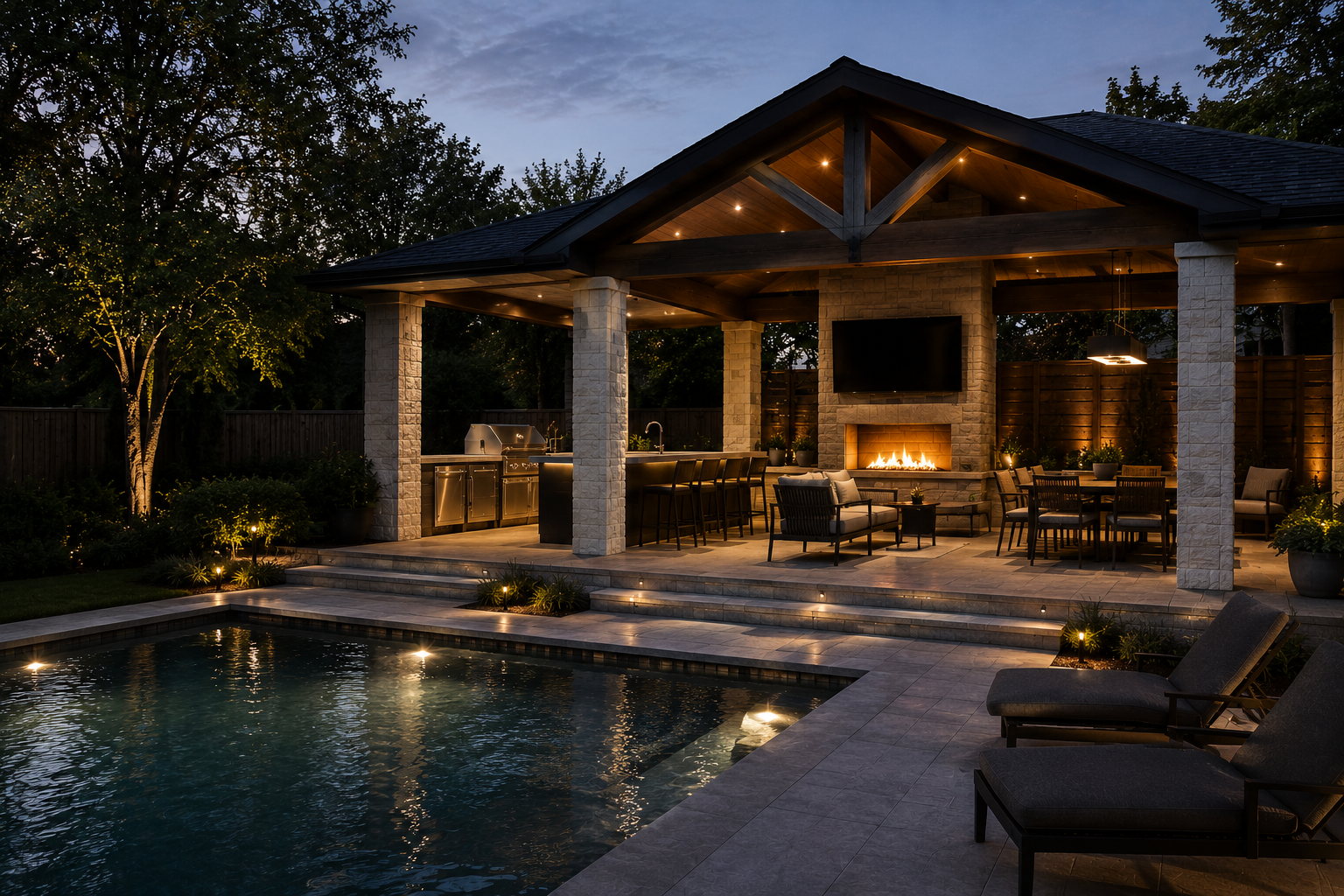
Introduction
Outdoor spaces are often approached as landscaping projects, defined by planting plans, hardscape layouts, and surface-level design decisions.
While this approach can produce visually complete results, it rarely delivers cohesive environments that align with the architecture of the home.
At Mediterra, outdoor living is approached differently, not as landscaping, but as an extension of architecture itself.
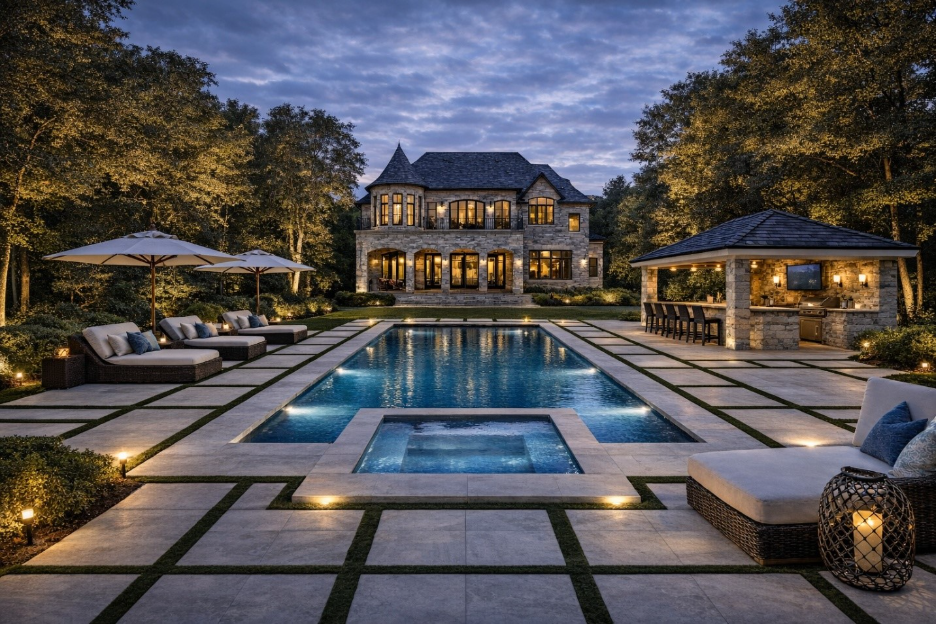
The pool, pavilion, and surrounding landscape are composed as a coordinated architectural environment, rather than a collection of individual features.
The Limitation of Traditional Landscaping Approaches
Traditional landscaping typically focuses on individual elements: patios, planting beds, walkways, and isolated features.
These components are often developed after the home is built, with limited consideration for architectural proportion, structural alignment, or how the space will function over time.
The result is often a collection of well-executed elements that lack cohesion — spaces that look complete, but do not feel resolved.
Outdoor Living as an Architectural Extension
Integrated outdoor living begins with a different premise:
The exterior environment is part of the architecture, not separate from it.
Pools, pavilions, terraces, and landscape elements are developed in alignment with the structure of the home. Axes, sightlines, and proportions are considered early, ensuring that each component reinforces the overall composition.
This approach creates a continuity between interior and exterior spaces where transitions feel intentional and the property functions as a unified whole.
This level of alignment allows the outdoor environment to read as a continuation of the architecture rather than a separate intervention.
Where Landscaping Falls Short
Landscaping, when approached independently from architecture, is typically limited to surface-level interventions.
While individual elements may be well executed, they are often developed without reference to structural systems, spatial hierarchy, or long-term integration with the residence.
This results in environments that appear complete in isolation but lack the clarity and cohesion of a fully resolved architectural composition.
Planning Before Construction Changes Everything
One of the defining differences between landscaping and architectural outdoor living is when decisions are made.
In many projects, outdoor spaces are addressed after construction, limiting what can be achieved and often introducing compromises.
By contrast, integrated outdoor environments are planned alongside the architecture. Structural requirements, grading, drainage, lighting, and material transitions are considered early, allowing for a higher level of precision and coordination.
This reduces rework, protects budgets, and results in a more refined final outcome.
Material Continuity and Long-Term Performance
Material selection plays a critical role in how outdoor spaces age and perform.
When outdoor environments are treated as separate from the home, mismatches in materials, detailing, and transitions become more apparent over time.
An architectural approach ensures that materials are selected and detailed in relation to the residence, reinforcing continuity and improving durability. Transitions between interior and exterior surfaces are resolved intentionally, rather than improvised on site.

Covered exterior spaces are designed in alignment with the residence, allowing materials, structure, and lighting to transition seamlessly from interior to exterior.
“Our approach to architectural outdoor living environments reflects this integrated methodology.”
Function Beyond Aesthetics
Outdoor living environments must do more than look good. They must support how the space is used.
Cooking, dining, gathering, circulation, and seasonal use all need to be considered within a structured layout.
By organizing these functions within an architectural framework, the environment becomes more intuitive, more efficient, and more enjoyable to use.
Integration as a Design Standard
At the highest level of residential design, integration is not an enhancement, it is a requirement.
Architects, designers, and clients working on significant projects expect environments that are resolved as a complete composition from the outset.
Outdoor living is not treated as an addition, but as an extension of the architectural framework. This requires coordination across disciplines, clarity in planning, and a consistent design language from interior spaces through to the surrounding landscape.
The result is a property that feels intentional, cohesive, and fully resolved rather than assembled in parts.
Conclusion
The difference between landscaping and integrated outdoor living is not simply one of scale or cost; it is a difference in approach.
When outdoor environments are treated as extensions of architecture, they achieve a level of clarity, cohesion, and long-term value that cannot be replicated through fragmented design.
For homeowners, architects, and designers across Toronto and the Greater Toronto Area seeking more than surface-level results, the distinction is clear:
Outdoor living, when done properly, is architecture.